All Posts By

SanghaWebmaster

Virya: Energy

By Teachings / Resources
Click here for the full article

Dear friends of the way and of Tenborin

The present circumstances plunge us in spite of ourselves into a “here-and-now ” we can choose to ignore by staying stuck to media, stress and endless commentaries, or feed with a consciousness which opens up to the beauty of nature (it’s springtime !!) and to the beauty of beings (so many generous daily actions !), that we can welcome anywhere in the silence of our own heart.

I am sure everyone one of us practices attention and generosity as well we can. We’ll have to be patient as the circumstances of the lockdown appear that they could last.

In order not to bounce back on usual media coverage, I have chosen to offer you teachings I am aware are a bit long. But one cannot talk in a few words about the teachings of the Buddha. It was a great pleasure for me to work and synthetize them.

The paramitas I haven chosen to comment upon are really relevant today, and must bring to everyone of you guidelines for reflection and behaviour. Download these “tenboring” and keep these « teihso » for quiet reading in the future.

On the other hand, we are doing our best to organise the future of our sangha and of the zen centre of Lanau. We will keep in touch with you any time things get clearer, and send you information and invitations to practise in respect with everyone‘s safety.

” Continue zazen eternally » used to say our Master Deshimaru when he would leave us to travel to Japan  for a few months. « Authentic practise has no beginning nor end ”

I do hope with all my heart to see you soon.

– Guy Mokuho

Ksanti: Patience

By Teachings / Resources
Click for the full article

Ksanti : Patience (Nin in japonais) by Guy Mokuhô Mercier

All the difficulties and sufferings of beings have one cause. To resolve them or free oneself from them, we need to take the time to examine ourselves, study ourselves. This is Buddhist practice explained by Buddha in his first sermon at Benares, on  the Four Noble Truths.

The practice of the paramitas is inseparable from the fourth Noble Truth, which describes the stages of an eightfold path leading to the end of suffering.

Vimalakirti and the sickness of all beings

By Teachings / Resources

Sickness is present everywhere in the world, this is a fact. We all know about so  many sufferings which result from it, and feel ourselves to be totally powerless in such a situation. At this moment, we see true acts of generosity appear spontaneously, and exemplary conduct just like that of bodhisattvas, who  symbolise the Buddhist ideal, but at the same timeme, really horrible attitudes and an inextinguishable thirst in some who try to profit from this suffering.

Click here to read the whole newsletter

A Message from Guy Mokuhô Mercier – Regarding Confinement

By News

Hello dear friends of Tenborin.

I hope you are all well

At this time when everyone is obliged to stay at home, we feel even more the need to come together just to sit and practise the Way of Buddha.

Advice is generally not followed to a great extent, but if we want to stay calm and centred on what is important, this is what I suggest : each one of us should sit to practise zazen at the same times we would have at the dojo, before this period of confinement. This is a way of sharing the space of Presence, to unite with all beings and to pay homage to those who have transmitted the teachings of Buddha to us.

This confinement will last …. 

So we will send some reflections to you on a regular basis, along with teachings and announcements, so that our sangha, along with all the others, remains awake, alive and preserves in our hearts the calm that zen teaches and the profound desire to act as a Bodhisattva for the good of others.

So, here’s the first message:

Confinement and Solitude.    

A calm night, beneath the empty window,
Sitting in meditation, wrapped up in my monk’s robe,
The navel and nostrils well aligned,
Ears and shoulders on the same axis.
The window is white, the moon is about to come out,
The rain has stopped, some drops still fall.
At this time, my feelings are extraordinary,
Huge, immense, and only known to me.

Ryokan

Sometimes we dream of being alone, like Ryokan in his hermitage in the mountains, when the pressure of others, the media, and other phenomena overwhelm us, oblige us to be always adopting an appropriate composure, to play with all the facets of our personality and continue to appear.

We would like to feel better, but sometimes we no longer know how to get out of this condition, where to go, who we can trust or confide in, and what we can think of to avoid getting bogged down or even falling. We’d like to stop running, to stop time, or even just stop.

And then circumstance brings along a truce, a moment of respite, and time seems to stand still. It’s not what we were expecting or even hoping for, far from it. It’s even an additional pain which purpose it is hard to see, when everything is turned upside down by a single little invisible germ!

The feeling of isolation, of restricting confinement, hard to live through, seems impossible to overcome for some. We start to doubt ourselves, truly alone, even amongst thousands of others! We’d like to retreat high up the mountain with Ryokan, and see ourselves looking at the beauty of the countryside, whilst at the same time bitterly understanding that that only exists in our imagination.

The landmarks and habits which allow us to mark out our personal space, our relationships with others, the routines of everyday life, our professional activities are suddenly with one stroke tipped over, wiped out, swept away.

Our immediate temptation is strong and almost atavistic, to invent new games for ourselves, to make our usual distractions and virtual games last longer and longer, in our often very confined homes. And to try to escape once more from this isolation, which we pejoratively call solitude.

And yet this reversal of the principles and habits of everyday life is a good moment to discover and explore true solitude and find an authentic path of sharing and communication with others, true compassion.

Confinement is necessary, but it isn’t a question of solitude.

Solitude has quite a different scent. We smell it when we are able to free ourselves from the past and from the worry of what may come in the future, when we welcome the present moment like a newborn, opening his eyes for the first time.

True solitude is the real place of purity and innocence, from which arise all possible futures, all constructive energies. It is creative light, rising up from darkness, free of all contamination, beyond ignorance and suffering. It is emptiness.

Can we look at this deep solitude, quite simply, just as it is, without trying to run away from it, without dressing it up with words, masking it with a thousand commentaries, without feeling afraid of being nobody?

The scent of solitude frees our mind from its karmic chains, and its attraction to the ten thousand things. It’s like the smoke of incense that spreads in the space of consciousness.

When the mind joins with this solitude, it finds its source again. Fears dissolve, doubts are only doubts, and things go back to their anonymous form in the heart of this Presence which melts and unites all existences.

The scent of this solitude, pure and simple, spreads out in the heart of our meditation. The scent of One, Shikantaza.

Have a good practice everyone! Let us continue zazen with courage.

With all my fond wishes for the beginning of Spring.

~Guy Mokuho

Editorial by Guy Mokuhô – Ko Shin

By Teachings / Resources

Editorial Guy Mokuhô – October 2019

Ko shin is the attitude of the mind we must attest in zen.

Ko shin opens up from the sincerity of our meditation practise and from our real understanding of the bodhisattva ideal and Buddhist values.

Ko shin is the spirit parents and grand parents have towards their children and grand-children. It’ s a spirit of kindness and benevolence which gives without searching for profit and restricting oneself. Whether they are poor or rich, parents have the same feeling of love towards their children. They are careful and patient ; they give, teach, transmit the best of themselves. They are protective, keep danger away and willingly make sacrifices without even mentioning it.

Without Ko shin there is no authentic practise, and the bodhisattva realization cannot be separated from it.The Buddha put this virtue ahead off all others as it lightens up the entire universe :

« Benevolence is this freedom of the heart which embraces all paths in the brilliance of its splendour. In the same way that at the end of the rainy season the sun rises in a clear cloudless sky and let its brilliant light absorbs all darkness, in the same way that at the end of a dark night the morning star shines in its glory, no practise which permits spiritual progress has the sixteenth part of the value of benevolence, as it embraces them all and bursts into light ».

Let’s learn and practise together this primordial virtue. It completes and impregnates Ogu •

The meaning of OGU – by Guy Mokuhô Mercier

By Teachings / Resources

The Meaning of OGU – By Guy Mokuhô Mercier

Ōgu expresses the “transmission”.

We transmit through our practice this same form and rituals that have been transmitted and taught by teachers for centuries. They are still practiced today in the temples of our Sôtô school. This transmission allows us to preserve and protect what the Buddha taught : keep one’s own attention steady and continuous, whatever the circumstances, to see and understand the truth of impermanence and emptiness. We learn this directly during zazen : to remain motionless and to see the impermanence of things, to remain in the Consciousness-Presence that sees the world appear and disappear.

One of the most delicate and profound practices transmitted in Zen Soto is the one we do while eating in the Öryoki.

To keep this stable and calm mind that observes and contemplates is a difficult practice that requires us to seek the advice, recommendations and experience of our masters. Our mind is accustomed to divide itself by identifying itself with the things it perceives, by projecting onto them to try to seize them to gain a satisfaction that it cannot manage to see as useless and even perverse. To identify oneself with something impermanent can only produce in us a feeling of total insecurity, while creating in us the fear of missing something. We spend our life in the contradiction of wanting to grasp what makes us suffer and simultaneously trying in vain to escape this suffering.

Keeping the attention steady is really the basis of the Buddha’s teaching (expressed very explicitly in the Satipatthana sutra) to learn through meditation and the practice of the paramitas, to dwell in this gaze that contemplates the appearance and disappearance of things. In meditation, we realize this, without even being aware of it. Unfortunately, it is difficult and even impossible to contemplate 24 hours a day. Life and energy push us to undertake things, to act, to create, and so the difficulty is to keep this stability of consciousness perceiving things themselves, equally in activity and in meditation. This is what Zen teaches in the care given to the details of everyday life, in the spirit of gesture, these ways which are the foundation of spiritual and monastic life, to make us reach the other bank. The other bank qualifies the spirit that dwells in stability, motionless within the very heart of the movements of impermanence.

One of the most delicate and profound practices transmitted in Zen Soto is the one we do while eating in the Öryoki. It is a practice that symbolizes the gift and the non-attachment. For those who do not know our tradition, the Oryoki are the set of bowls, five bowls, sometimes even seven, in which the Zen monks take the meals. This ritual is extremely precise and requires us to maintain constant attention throughout our meal.

The word ” Ōryoki ” is composed of three ideograms (kanji) :” Ō ” means the response of the recipient to the food offering. ” Ryō “, is the quantity that we receive in our bowl.” Ki “, is the bowl itself.

Let’s start with the bowl – Ki.t is in itself a symbol. It is the bowl that receives and contains the life that nourishes our existence. The largest of the bowls, the one that contains all the others, is called hatsu.u. and it symbolizes the transmission of life, of the Dharma, and also of the teaching of Buddha. Dogen writes that it is «the unimaginable, extraordinary, incomparable, wonderful, miraculous utensil in which this extraordinary event is realised, the gift of food, this exchange with others and with nature. And for this event to take on its dharmic, extraordinary dimension, it takes place in Presence «. Eating in this bowl is an act of presence, Consciousness-Presence. This is the very place of enlightenment. The bowl transcends the idea of the bowl itself, its material form. It becomes by the attentive presence the place where practice and awakening are realized. In the Buddhist tradition, this bowl is also used as a bowl of alms. At the time of the Buddha the monks went to the villages to beg for food. This practice is still ongoing, although rare today.

Ryō “,is the measure, the quantity we receive in the bowl, the quantity given to us. Whether small or large, it is not for granted or by right. We must learn contentment and truly consider that it is a gift made to us. The contents of our bowl, “Ryõ”, is the life that presents itself to us at this very moment and invites us to consciously consider eating, the pleasure of tasting the universe in flavors and colors. Our greed often turns this food into something banal, by the carelessness we bring to it and by the judgments we make in our minds about the contents of our bowl. This very quantity of food, “Ryo”, reveals to us the power of our attachments and our dependence on the world of our sensation of taste.

ClauqettesRyō, is not only the food itself in our bowls, but it is also the abilities, skills, qualities that each of us has received and that we must put at the service of others. As the Buddha teaches us, there is nothing that belongs to us. As a result, we can consider our body itself as a bowl that receives food and restores it to others in the relationship of love and sharing. The bowl receives food and it transmits life! We also receive, transform and return this food. It disappears in us and turns into an activity that we must transmit and put at the service of all beings.

Ō “, is the response of the one who receives, to the food offering. We can always complain about what’s in our bowl! The spirit with which we receive food can either make us sick or wake up and nourish our spirituality. Whatever is in our bowl, we can taste it and discover the flavors, the textures and see the colors and go beyond the judgment of thoughts, to study this and see if we can take the time to enjoy, to chew, to be conscious with food. This is the teaching of Õryokis. Our attitude of mind determines how this food will be transformed and used by our body. The response to the food offering is a quality of care devoid of judgment and greed and is the expression of our gratitude. Zen expresses the relationship between the one who gives, the one who receives and what is given by the term “Ogu”. We have already seen what» O «means. The response of the monk who receives his food in his bowl is to give back to beings by teaching and transmitting the Dharma. This is his «task» in the play of interdependence between all beings. ”

Gu “, is the offering itself that fills the bowl, the action that the donor accomplishes, the action of giving, the gift itself, without a mind of profit. The true gift does not wait for a reward. “Ogu” really corresponds to «Dana», the gift, the first of the paramita practices of perfection. The lay person gives the food and the monk gives the Dharma, the teaching, of which it is said that, of all the gifts, it is the most important.

Ōgu “, is also the perfect uniqueness that is created in the action between the one who gives and the one who receives. It is the heart of Zen to give and receive. They are synonymous, one does not go without the other. We do not come to the dojo to get something for ourselves. We come to discover who we are and restore this truth to all beings. The practice of “Ogu” therefore includes ourselves and others.

Ōgu ” is the name we have chosen for the seminar we will be doing in Lanau at the end of October 2019, followed by a sesshin (we could also say Ö-sesshin). The idea contained in this term is to transmit generously what we have received. It is the transmission that continues to live beyond the form, the body and the things that pass. The way of the Buddha is a way of humanity for all beings. As his disciples we must through our practice convey the path that allows the return to That which we are.

Taitaiko Go Gajariho – “Pure Standards for the Zen Community”

By Articles

Taitaiko Go Gajariho – “Pure Standards for the Zen Communnity”

Byu Sebastian Mokusen Volz

Master Dogen, in an early period in Kyoto developed the essential teachings on the path and essence of Zen, emphasizing the effectiveness of Zazen in the Shobogenzo.

After this period of 16 years, he founded Eihei-ji and developed the teachings for a continuous practice appropriate for monastic life. This practice has its source in Zazen and is organized around the platform where the monks do Zazen.

During the Ango that I experienced last year, this monastic life seemed to me to be organized so that surrender to the path is complete. Since the cycle of the days is pre-established, adapted to the nature and the balance of the human being, there is no more choice to make and the mind relaxes. Life flows smoothly and the mind that does not seek gain, Mushotoku, is realised.

The fourth part of Eihei-ji’s rules concerns correct behavior when meeting experienced teachers. This experience is measured in number of Angos. Five confer the position of Atari-teacher, ten that of Osho-priest.

The sixty-two rules that are set out in the chapters are designed to establish a state of respect between the teacher and the monk, so that the learning is done verbally and non-verbally.

To reveal the meaning of this respect, here is a little story :

“An impetuous and proud Samurai entered the temple of an old monk one day. Without warning, he burst into the room where the monk was going about his business. And then he imperatively asked:

“Reveal to me the secret of paradise and hell ! ”

The old monk smiled and said to him :

“A man as stupid as you is not able to understand.”

The Samurai, outraged and dominated by anger, drew his sword and threw himself at his interlocutor. Just as the sword rose in the air to strike, the monk uttered in a powerful voice.

“This is hell “.

Impressed and stunned, the Samurai stopped immediately. Realizing the meaning of the words he had just heard, he prostrated himself. At this precise moment, the Master made this revelation to him,

“Here is paradise”.

The sixty-two rules can be summed up by the mind of this prostration in the face of revealed truth. This truth is expressed through the body of this Taitaiko who lived five or ten Angos, through his gestures, his aura and his words.

The abbot of the temple where I spent three months, spent his life practicing Angos. His eyes are brilliant, his voice very gentle, his gestures particularly fine. He always evolves silently and discreetly. He sees everyone’s mistakes. He says nothing and let the monks take responsibility, unless the mistake is repeated. A natural respect for him is established.

The rules of the temple are also established in order to dignify him : his entrance to the refectory and to Chosan, the formal tea of the morning, is made to the sound of the drum. Finally the monks only see him on the occasions that are relevant to practice such as zazen, Oryokis and Samu. He sometimes calls a monk to Tokusan for an interview. He meets Shusso and Tenzo daily and is assisted by a monk or a nun. While he seems unattainable and elevated by the rules of the temple, he shows profound simplicity and kindness when the opportunity arises to interact with him.

For us who have been educated in an egalitarian society the sixty-two rules are difficult to understand and accept. They are aimed at simple behaviors such as : « Do not look at a Taiko when leaning on something with your legs crossed » « Do not look at a Taiko with dangling arms ». As well as obviously misplaced attitudes : « Do not spit in front of a Taiko »

Beyond inappropriate behavior and words, it is essentially about creating a student-teacher relationship. «Always demonstrate a humble spirit» or « If there is a discussion, remain humble and do not try to gain a higher position”.

And it is also important to take care of the teacher : « Always observe the expression of Taiko and do not cause him disappointment or inconvenience ». Then « If a difficult task is to be done where a Taiko is, do it yourself » « If there is something nice to be done, suggest that he does it ».

Although these rules were primarily aimed at young monks, they truly create a harmonious atmosphere in the sangha and they invite Taikos to take great care of the members of the community.

Tenboring #07 – Octobre 201912As for me, when I am in the presence of my Master Mokuho, I have always felt a spontaneous respect for him and often thought that I should find the time to make Sanpai in his direction. But not knowing the rules of Master Dogen, I have often been clumsy.

The teaching of Buddhas reveals that there is no border between others and ourselves. The others are also inside us and when we raise them up, we rise with them. This unity between us and others on the one hand, and between us and our mind-body on the other hand, is called Jijuyu Zanmai by Master Dogen. Jijuyu Zanmai is a samadhi of joy from the fulfillment of oneself. This accomplishment is realized in Zazen when we become intimate with ourselves. It is also realized in the temple when we become intimate with the rules.

How to become intimate with the rules? They may not please us and may even shock us sometimes. During the Ango where we are observing the rules at every single moment, the ego reacts and tries to escape. Three indications can overcome this reaction : The first step is to have confidence that these rules are designed to free us and lead us to enlightenment.

The second step is to integrate them in harmony with those who realized them. Master Dogen calls them the « pure assembly ».

Finally, it is important to realize that these rules are like those of a game. These are codes that allow us to interact with others and with objects. As the game progresses, it becomes unconscious and it purifies our gestures, our words and our thoughts. In a game, everyone integrates rules in their own way. Thus, even if the rules are unique, they manifest themselves in very different ways through each one of us : the ego and the rules harmonize with each other, as in a dance where everyone takes his turn. Dance with the rules!

In conclusion, even if Master Dogen establishes forms for teaching to be transmitted, do not for a moment forget the profound equality of all members of the Sangha when he writes: «The brothers and sisters of the family of the Buddha should be closer to each other than to their own self. « Or explaining that “you should know that temporarily we are hosts and guests, but through our whole lives we will be nothing but Buddhas and Ancestors ». •

Tales, Legends in the Transmission of Zen by Jean Marc Kukan Delom

By Articles

Tales, Legends in the Transmission of Zen by Jean Marc Kukan Delom

By Jean Marc Kukan Delom

Zen is full of stories and tales from multiple sources, reworked, told and polished over time.

Tales and stories do not speak of religion or transcendence but simply of the human being and the world. They are the living expression of Dharma. There is no morality, no absolute truth. When reading them, if we understand their meaning, the invisible becomes visible.

The common point of all Zen schools is the master-disciple relationship.

“The main role of the master is to transmit the three pillars of Zen, to settle, to go beyond the mind, to act without expecting anything (Mushotoku)”. In Zen, transmission, the master-disciple relationship becomes more important than the study of texts and sutras. We discover how the disciple penetrates emptiness through non- meaning. The me of the disciple fades away, the vision changes, starting from an egocentric functioning towards a heliocentric dynamic, then towards a non-dual vision, finally reaching the vision of the heart. Here are three examples of transmission :

The Buddha’s Flower

One day, the Buddha showed a flower to an assembly of one thousand two hundred and fifty monks and nuns. The assembly was perfectly silent and sought to understand. And then, suddenly, the monk named Mahakashyapa smiled and the Buddha smiled back at him and said, “This treasure of insight, I transmit to Mahakashyapa.”

Why did Mahakashyapa smile?

Perhaps it just shows his joy and happiness. Joy is the living expression of realization. But the Budhha also knows the limits of words. He has omniscience in omnipresence. As the senses perceive objects and construct ideas, the mind conceives thoughts. We build and manipulate ideas, but in itself, these are just ideas that lead to an activity called Karma. Reality can not be expressed as long as one thinks reality, or one speaks reality, but it must go through a direct experience.

This first transmission also invites us to open our heart. To relearn how to see, see and contemplate a flower, a tree, a stone and this other one, in its similarities and differences. And so between attachment to the pleasures of the senses and renunciation of these pleasures of the senses, to find Knowledge.

Knowledge, which is like birth. Inwardly turning, as the child turns into the interior of his mother’s womb, and being reborn in the moment to this existence, in this balance that leads to wisdom.

Returning to this simplicity of being in the moment, in this simple conscious presence, living in the spontaneity of a child, Mahakashyapa received, with a smile, the transmission of the Dharma

The first Awakening from Taiso Eka 2nd patriarch of Chan zen (Hueke)

Taiso Eka, following the instructions of the Indian monk Boddhidharma, the first zen patriarch in China, having practised zazen for a long time beside him, asked him:

Master my mind still does not find rest,

Show it to me, replied Bodhidhama and I will purify it!

I can not grasp it …

Boddhidharma exclaimed :

Then, I have purified it!

And the disciple knew his first awakening. In zen, Dokusan s the term that characterizes this exchange. Doku : going alone – San : to the one who will perfect our learning.

Thus a permanent dialogue is established through verbal exchanges or tasks to be performed, which are meant to make the disciple advance on the way (oshie) to enlightenment (satori).

Zen insists on a regular and constant confrontation.

Dokusan is not just a meeting once a year. It is the expression of a common approach that is accomplished over time, in an intimate relationship whose purpose is to get the mind out of his drowsiness, his habits, his packaging.

In this short exchange, Bodhidharma does not answer Taiso Eka’s question with a descriptive, or prescriptive word, saying what to do or not to do. His words are performative, that is, they are an act in itself, thus causing a change in the other.

Transmission of Hyakujo – 10ème patriarch of Zen, Obaku

Certain circumstances can lead to violent situations..

Hyakujo questioned Obaku after picking mushrooms.

Hyakujo asked him if he had seen a tiger. Suspecting that Hyakujo was launching a dharmic fight, Obaku uttered a loud groan.

Huakujo brandished an ax as if to hit the animal, but the disciple grabbed the master and punched him. Hyakujo burst out laughing and the same evening announced to the other monks: “There is a tiger in Mount Taiju. Beware of him, this morning he bit me.”  In pronouncing these words, he had just designated his successor in the dharma.

As it is said in the Fukanzazengi: “You must therefore abandon a practice based on intellectual understanding, running after words and keeping you to the letter “.

For the readers that we are, the methodology of this story invites us to a kind of hermeneutical experience, interpretative beyond words. Tradition becomes language without being tied down by it. The tradition becomes timeless, impersonal, universal and simply alive.

Soto Zen kept this in its method of transmission through the Hossenshiki ceremony which dedicates a shusso, as the first disciple or monk of the first row.

This ceremony does not confer a diploma, nor is it a degree of ordination. Hossenshiki literally means “Ceremony of Dharma Combat”. Through a series of questions and answers and very precise gestures, the Shusso certainly demonstrates his knowledge, but he especially updates his personal commitment to the service of the community, of all people. It’s the spirit of the big brother, the big sister. He expresses his determination, certainly by words but above all by his bodily attitude in a body-mind unity.

Hokyo Zanmai helps us to understand this ceremony. “The meaning does not lie in words, but the appropriate moment makes it appear “.

In conclusion, Zen stories and tales tell how the disciple, in this visible world which is common sense and yet not separated, must live Returns, Turns and Renunciations. For this, Zen Masters have used :

  • Silence
  • Destruction of image and beliefs.
  • Means of communication such as gestures, screams and paradoxes
  • The “public case” (koan)
  • The “beginning of a word” (huatou)
  • Poems

Like the Buddha, they taught with skilfull means or rather they were skilfull in their means. Exceeding any notion of separation, this transmission could not take place without benevolence, quite simply in the love of one.

Transmission for and according to Dogen by Jean Zanetsu Zuber

By Articles

Transmission for and according to Dogen.

By Jean Zanetsu Zuber

At the end of this July camp there will be ordinations of nuns and bodhisattvas. During this ceremony, the teacher transmits the teaching of the Buddha, and he gives several things that symbolize and materialize this transmission: the precepts, a new name, the ketsumyaku, an act that certifies their blood line in the Dharma with the Buddha, through the master who ordains them, and a rakusu. Monks and nuns also receive a bowl and a kesa.

I would like to dwell on the transmission, such as Dôgen presents it in the Shôbôgenzô, in the Menjû chapter.

Transmission, the heart of our practice.

The event, both in time and beyond time, which is the foundation and the heart of our practice, it is the Buddha’s Awakening and the transmission of this Awakening in order to save sentient beings, to «bring the multitude of beings to the ‘other shore’. The Buddha transmits the Dharma, the Law, which is in fact the natural functioning of the Universe: an interdependent Universe, impermanent, and therefore not-self, emptiness.
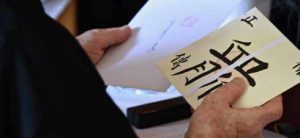
This transmission can only be from one Awakened being to another Awakened being, and it is manifested in the story with the famous episode of the flower that the Buddha turns between his fingers and opens “Menju”. This chapter is a meditation on the transmission that is given and received (jü) through the face (men), in other words face to face transmission. Sitting in the midst of a million followers, the enlightened Shâkyamuni twirled a flower (…) and blinked his eye. At that moment, Mahakasyapa smiled at him (…). The awakened Shâkyamuni then said:  “I have in me the True Law, the treasure of the eye, the sublime heart of Nirvana, which I transmit to Kasyapa”.

For Dogen, this even is  “the principle of the Way according to which the true Law, Treasure of the Eye was transmitted face to face from one who is awake to one who is awake, from a patriarch to a patriarch, from generation to generation”. The Eye of the Awakened One is the true vision of things, beyond our illusions and our dualistic vision. It is the vision of the enlightened, which is beyond our human eye.

Dogen notes that this transmission has been without interruption since the seven awakened ones of the past (Shâkyamuni and the six Buddhas who precede him) to his master Tendô Nyojo, and that this transmission is none other than the “realization as the presence of the gateway of the Law, transmitted face to face from an awakened person, from a patriarch to a patriarch”.

Dôgen and Nyojo

The transmission received from Master Nyojo was for Dôgen an essential event:» First, I offered incense and I prostrated myself ceremoniously before my late master, the old Buddha Tendô [ie Nyojo] in his private apartment …). He too saw me for the first time. Then he gave me the Dharma face to face, our fingers touching each other, and said to me : « The door of the Dharma of the face to face transmission, from Buddha to Buddha, from Patriarch to Patriarch, is instantly realized. « in his eyes, this transmission is the equivalent of the flower transmitted to Kasyapa, the transmission of Bodhidharma to Eka, the 2nd Chinese patriarch, and the transmission of the fifth Chinese patriarch to Eno.

The chapter ends with the same episode, which further underlines the importance of the event. Dôgen says: ” I was able to accomplish the transmission face to face, abandoning the body and mind, and this transmission I have established in Japan”.

What Nyojo transmits to his disciple and what Dôgen will bring back to his country, is shinjin datsuraku, giving up the body and mind, and thus returning to our original Face. To live this experience means to personally experience what the Buddha knew under the Bodhi tree, during his Awakening.To realize this, the only practice is that transmitted by the Buddha: shikantaza, to sit (za) without (shikan) doing (ta) anything, without trying to reach anything (especially not enlightenment), without turning a problem around in one’s head (for example the kôan of the Rinzai School). This zen that Nyojo received and transmitted face-to-face to Dôgen, is the silent awakening of Buddha Shâkyamuni, the essential experience that is the foundation of Buddhism. This experience is that of the unity of body and mind which are no longer two-matter and spirit – but unity realized in samadhi, in concentration. Then, our true nature appears, what is called our Original Face or Buddha Nature.

At the same time, this zazen can not be an individual zazen, centered on the attachment to our Awakening. Nyojo emphasizes that if this were the case, we would miss the great compassion of the Buddhas and the Patriarchs who practice zazen only to save sentient beings. And he adds, “When Buddhas and Patriarchs sit in zazen, they form from the first day the vow to unify the entire universe. No sentient being can thus be forgotten or abandoned. Their spirit of compassion extends to the insects and the merits of their zazen are offered spontaneously and unconsciously for their salvation”.

Dogen thus starts from this essential element: « (…) with each generation, the authentic Patriarchs continued the transmission face to face, the disciple looking the master in the eyes and the teacher looking the disciple in the eyes. A Patriarch, a teacher or a disciple can not become a Buddha or a Patriarch if they have not received this transmission face to face ».

Transmission is thus giving AND receiving through the face and the eyes, an idea that is included in the word jû de jûmen. Ju, it is both giving and receiving, and in this case it is done through the face (men) and eyes, because in the transmission from master to disciple, «each one of them offers the face to the other, only face to face, and each receives the face of the other. « This explains the importance that the masters give to the exchange of glances during the ceremony of transmission or in greeting in gassho. This is the silent transmission, that of Buddha turning the flower, transmission from heart to heart (i shin den shin), beyond the Scriptures, and without intermediary, transmission which is still materialized through the “ pai” between the master and the disciple during the ordination
But this transmission remains fundamentally one: ” [This transmission] is like pouring water into the ocean and increasing its extent endlessly. It’s like transmitting the lantern and allowing it to shine forever. In the thousands of millions of transmissions, the trunk and the branches are one “.

And Dogen concludes, “From now on, the great path of the Buddhas and Patriarchs consists only in giving and receiving face to face, receiving and giving face to face; there is nothing that is too much and nothing is missing. You must understand it faithfully and joyfully, when your own face meets someone who has received the transmission face to face.”

“And this transmission continues until today” The smile that illuminates the face of Mahâkâsyapa does not stop.

Editorial – June 2019 – A New Spirituality?

By Teachings / Resources

What kind of spirituality does our world need today?

It is an unimaginable challenge to try to innovate by oneself without relying on personal ideas, our preferences or dislikes. Every personal opinion is limiting for others, but also for oneself. Every  evolution must be inspired by a true mind of compassion, that is to say free of all traces of ego.

Zazen is a spirituality which is always new, beyond fashions, which gives immediate access to oneself, and as Master Deshimaru would often say, is the essence of religion. However, the Zen  tradition also uses a lot of ritual to accompany and transmit the practice, and this really upsets a lot of followers and sympathisers. The question of whether ritual is well – founded or necessary must be asked, as it seems that its use is discouraging people who aspire to a spirituality that is free from traces of the past.

The collection of rituals practised by a group comes under the term liturgy, which means ‘service for the common good of all.’ The life of a group, a nation, a sangha, structures and organises itself by adopting a form, a religious or lay ritual, put in place via group meetings or practised on the occasion of certain life events ( birth, death, marriage, changing seasons). In the West, it seems that our system of reference, based on a cartesian and scientific approach, alongside the residual image of the ‘christian’ religion of our parents, has become an obstacle and constraint to our  spontaneous acceptance of zen.

However, whether we realise it or not, we are always subject to personal or group rituals which continually reaffirm our life choices. This is how we do our morning rituals, brush our teeth, get dressed, take coffee, arrange our affairs, and even satisfy our addictions.. Everything is a ritual ! And in our collective life, how many rituals there are in school, the army, a football stadium, any  group, the boy scouts, wine lovers… all of which lead us to formalise a secure group identity. Zen rituals, whatever the intention guiding their appearance over the course of time, have for their goal  to affirm the non-separation of essence and form (Ku soku ze shiki) The practice of ritual in an awakened mind continually reaffirms this non separation between the ‘me’ and the ten  thousand things, between me and the whole universe.

Our essential truth resides in total adhesion to the present moment, the only reality of our existence. So , whatever we do, what we practise with a free heart is what we are. The‘me’ disappears to  reveal the Buddha, the Reality of all things.

The conscious implication, free and fully accepted, of a liturgy filled with meaning, helps to realise this non- separation from the essence. Everyday life manifests in a disinterested form which  helps our mind to come back to the source. It is like a meditation which continuesright into the activity of the body and the thoughts. This is how rituals and ceremonies become pure presence  which transforms the totality of ourselves. This is what it is to create a new spirituality which lives in the everyday.This is zen in its completeness. It is with this mind that we can create a  spirituality that speaks to all beings. •

“Is there anything outside the instant?
Acting without considering their
confidence, forgetting all self interest, the
person who, with full attention, with a
simple gesture places a stick of incense in
the bronze pot at the foot of the Buddha,
manifests the truth of the awakened
ones.”
~ Nan Shan