
New Program on FRENCH Television – Buddhist Wisdom – With Guy Mokuho
Mokuho talks about Project Gendronniere 2035 at the annual conference of European Soto Zen Teachers .


 Letter to a friend
Dear Fabien,
You suddenly disappeared into invisibility, and that took us all by surprise.
At 11:00 on Tuesday morning, I exchanged a friendly text message with you.
You told me we’d be seeing you again soon at La Gendronnière.
On Tuesday evening, your light was blown out by impermanence,
like a candle swept away by a sudden gust of wind.
If that’s your rather abrupt way of teaching us about impermanence,
you who would have had great difficulty explaining it to us in words,
well, you’ve succeeded.
Radical as well as spontaneous.
There will always be someone like you to provoke us
and make us think about life, suffering and inequality.
I met you at La Gendronnière in ’92.
You were a good companion on the Way.
At the time, we were swamped with major roadworks and upgrades.
You drove the tractor through the forest, as wild as it was,
a gruff companion to disturb the over-mannered spirits
and prune superfluous reverence.
Sometimes lost in the fog of your thoughts,
or tinkering with useless things, walking in the hills,
you’ve never stopped letting your creativity flow,
a bit of a tramp, a bit of a genius,
a provocateur with an eye for the stars as much as for the battle of ideas.
After our adventure in Lanau, you had just retired
and you were still full of projects, interests, dreams and perspectives.
And now it’s all fading away so that at last, rather than as expected,
comes the time for rest, silence and non-action,
So don’t stop at death, and keep going,
sitting up straight, motionless in your new space of light
letting yourself be absorbed by the silence.
In any case, it’s always straight ahead.
And don’t worry!
Each of us also goes towards our death, which awaits us a little further on.
We never leave each other, with or without this ephemeral body,
in which the truth of being is revealed.
Death does not extinguish the silent and eternal Presence.
It does not extinguish what we have experienced together.
It does not extinguish your smiling face that returns to our minds
every time we think of you.
Death does not extinguish anything.
We never stop seeing each other in spirit.
We share everything there.
Our hearts go out to your two boys and their mother,
to all those you have loved, who have accompanied you and who have shared
your joys and your sorrows.
We are overwhelmed by sadness.
Let it resonate just for you, today, in our mouths,
the sutra of Great Wisdom.
You join her in the sad sweetness of our friendship.
May our song encourage all the Buddhas to come and take part in our ceremony.
You are already one of them for immeasurable periods of time.
We wish you a safe journey to Nirvana.
Guy Mokuho
Now we remember past times
Time passes quickly, death follows life
And when that moment arrives, it strikes like lightning.
But when that moment has passed, the waves calm down again.
Today, for you, Fabien, the causes and conditions of existence have come to an end.
We understand the impermanence of all things,
and that this death signifies entry into Nirvana.
In front of this coffin, we invite all his family, friends and loved ones
to offer this ceremony to the glory of all the Buddhas and all enlightened beings.
May the merits of the Great Wisdom sutra be offered to you, Fabien,
and accompany you on the road to satori.


(OGU 2: Giving, Receiving, Transmitting – Guy Mokuhō’s 6th book)
For more information and to order!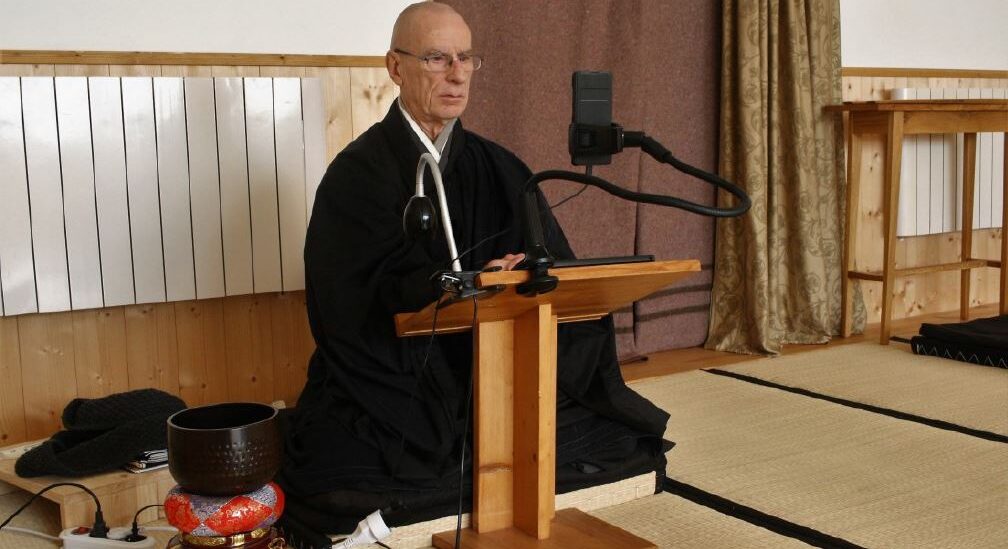
As a close disciple of Guy Mokuho Mercier (less than 150 km), I was moved to offer myself thinking that for this connection, there would be sounds to resonate or possibly other help to provide.
Actually no, everything was perfectly organized and simplified on site in Lanau. Many thanks to the shadow actor(s) who made this possible. I was therefore the only “in person” listener.
 The temperature wasn’t very high either at 8:30 a.m. From around 10am the time of Guy Mokuho’s start, a low late autumn sun, perhaps sensing the event, had been pouring into the dojo for a while. The temperature had doubled and was now very accommodating. The wood of the wall in front of me had taken on the color of honey, resplendent, the straw of the tatami a soft, warm color. Since summer has ended, these moments will become rare and precious in Lanau. Then the voice was raised…
Guy Mokuho was concerned neither by the emptiness of the dojo nor by the fullness of the telephone. Concentrated, he talked about Keisan, patiently, intimately, about the great liberation that “Seeing deepoing into everyday events” provides. It’s so simple, so true, so powerful.
It is very difficult for me to express how happy I was to practice with all of you, all alone on my zafu. I think many of you felt it too. I still wanted to share the image of the deep gassho that Master Guy Mokuho Mercier sent to all of you, the practitioners of the virtual dojo that morning.
P.S. This is the first time I saw a Zen master doing gassho in front of a mobile phone…

Hello dear friends of Tenborin.
I hope you are all well
At this time when everyone is obliged to stay at home, we feel even more the need to come together just to sit and practise the Way of Buddha.
Advice is generally not followed to a great extent, but if we want to stay calm and centred on what is important, this is what I suggest : each one of us should sit to practise zazen at the same times we would have at the dojo, before this period of confinement. This is a way of sharing the space of Presence, to unite with all beings and to pay homage to those who have transmitted the teachings of Buddha to us.
This confinement will last ….
So we will send some reflections to you on a regular basis, along with teachings and announcements, so that our sangha, along with all the others, remains awake, alive and preserves in our hearts the calm that zen teaches and the profound desire to act as a Bodhisattva for the good of others.
So, here’s the first message:
Confinement and Solitude.
A calm night, beneath the empty window,
Sitting in meditation, wrapped up in my monk’s robe,
The navel and nostrils well aligned,
Ears and shoulders on the same axis.
The window is white, the moon is about to come out,
The rain has stopped, some drops still fall.
At this time, my feelings are extraordinary,
Huge, immense, and only known to me.
Ryokan
Sometimes we dream of being alone, like Ryokan in his hermitage in the mountains, when the pressure of others, the media, and other phenomena overwhelm us, oblige us to be always adopting an appropriate composure, to play with all the facets of our personality and continue to appear.
We would like to feel better, but sometimes we no longer know how to get out of this condition, where to go, who we can trust or confide in, and what we can think of to avoid getting bogged down or even falling. We’d like to stop running, to stop time, or even just stop.
And then circumstance brings along a truce, a moment of respite, and time seems to stand still. It’s not what we were expecting or even hoping for, far from it. It’s even an additional pain which purpose it is hard to see, when everything is turned upside down by a single little invisible germ!
The feeling of isolation, of restricting confinement, hard to live through, seems impossible to overcome for some. We start to doubt ourselves, truly alone, even amongst thousands of others! We’d like to retreat high up the mountain with Ryokan, and see ourselves looking at the beauty of the countryside, whilst at the same time bitterly understanding that that only exists in our imagination.
The landmarks and habits which allow us to mark out our personal space, our relationships with others, the routines of everyday life, our professional activities are suddenly with one stroke tipped over, wiped out, swept away.
Our immediate temptation is strong and almost atavistic, to invent new games for ourselves, to make our usual distractions and virtual games last longer and longer, in our often very confined homes. And to try to escape once more from this isolation, which we pejoratively call solitude.
 And yet this reversal of the principles and habits of everyday life is a good moment to discover and explore true solitude and find an authentic path of sharing and communication with others, true compassion.
Confinement is necessary, but it isn’t a question of solitude.
Solitude has quite a different scent. We smell it when we are able to free ourselves from the past and from the worry of what may come in the future, when we welcome the present moment like a newborn, opening his eyes for the first time.
True solitude is the real place of purity and innocence, from which arise all possible futures, all constructive energies. It is creative light, rising up from darkness, free of all contamination, beyond ignorance and suffering. It is emptiness.
Can we look at this deep solitude, quite simply, just as it is, without trying to run away from it, without dressing it up with words, masking it with a thousand commentaries, without feeling afraid of being nobody?
The scent of solitude frees our mind from its karmic chains, and its attraction to the ten thousand things. It’s like the smoke of incense that spreads in the space of consciousness.
When the mind joins with this solitude, it finds its source again. Fears dissolve, doubts are only doubts, and things go back to their anonymous form in the heart of this Presence which melts and unites all existences.
The scent of this solitude, pure and simple, spreads out in the heart of our meditation. The scent of One, Shikantaza.
Have a good practice everyone! Let us continue zazen with courage.
With all my fond wishes for the beginning of Spring.
~Guy Mokuho

 Resting in the unborn –
RESTING IN THE UNBORN is the 3rd collection of Guy Mokuhō Mercier’s kusen. This booklet consists of five groups of kusen, delivered on various occasions, and a teisho on samsara, the wheel of life. The subject of this teisho has interested Guy Mokuhō for a long time and his enthusiasm is infectious!
As with the two previous collections, this 3rd booklet offers us a unique meeting between the subjects traditionally taught in zen and the particular way in which the author approaches them. To read Guy Mokuhō’s kusen is to enliven and invigorate our practice! Thanks to his teachings, we become particularly aware of the need to be conscious of our sensations. The booklet has about sixty paragraphs, in which Guy Mokuhō refers to sensations. Here are two examples, which illustrate this perfectly. They appear in the first pages of the booklet 3.
“Bringing your awareness to your sensations, following them as they spread out, and then disappear, is an instruction which allows us to come back into the flow of life, from moment to moment. The present moment is as it is, neither good nor bad.”
And a little further on:
“The more we become One with sensation, the more we feel life, which flows in heat, energy,, tension, waves, and the more our field of consciousness widens until it simply disappears in the sensation of being, which is not bodily. It isn’t an exercise which we can do just by personal will. We must let ourselves be. The sensation of being -or to take up the Buddha’s expression: pure consciousness of the presence of self.”
The more we become One with sensation, the more we feel life, which flows in heat, energy,, tension, waves, and the more our field of consciousness widens until it simply disappears in the sensation of being, which is not bodily. It isn’t an exercise which we can do just by personal will. We must let ourselves be. The sensation of being -or to take up the Buddha’s expression: pure consciousness of the presence of self What is more, coming back to the first quote, reading his kusen allows us to acknowledge that the present moment can only be pure: nothing is added, and it can only be felt, so, it cannot be willed.
If I could sum up in one sentence what I felt after reading this collection of kusen, I would say that knowing that these teachings are available whenever I want to read them again means that I can ensure a constant source of spiritual nourishment. •

On November the 8th, Sojun Matsuno roshi left us at the age of 89.
He is the master who agreed to p
ass on to me the Dharma (the Shihô) in the zen soto
tradition.


