Category

Teachings / Resources

Editorial – June 2019 – A New Spirituality?

By Teachings / Resources

What kind of spirituality does our world need today?

It is an unimaginable challenge to try to innovate by oneself without relying on personal ideas, our preferences or dislikes. Every personal opinion is limiting for others, but also for oneself. Every  evolution must be inspired by a true mind of compassion, that is to say free of all traces of ego.

Zazen is a spirituality which is always new, beyond fashions, which gives immediate access to oneself, and as Master Deshimaru would often say, is the essence of religion. However, the Zen  tradition also uses a lot of ritual to accompany and transmit the practice, and this really upsets a lot of followers and sympathisers. The question of whether ritual is well – founded or necessary must be asked, as it seems that its use is discouraging people who aspire to a spirituality that is free from traces of the past.

The collection of rituals practised by a group comes under the term liturgy, which means ‘service for the common good of all.’ The life of a group, a nation, a sangha, structures and organises itself by adopting a form, a religious or lay ritual, put in place via group meetings or practised on the occasion of certain life events ( birth, death, marriage, changing seasons). In the West, it seems that our system of reference, based on a cartesian and scientific approach, alongside the residual image of the ‘christian’ religion of our parents, has become an obstacle and constraint to our  spontaneous acceptance of zen.

However, whether we realise it or not, we are always subject to personal or group rituals which continually reaffirm our life choices. This is how we do our morning rituals, brush our teeth, get dressed, take coffee, arrange our affairs, and even satisfy our addictions.. Everything is a ritual ! And in our collective life, how many rituals there are in school, the army, a football stadium, any  group, the boy scouts, wine lovers… all of which lead us to formalise a secure group identity. Zen rituals, whatever the intention guiding their appearance over the course of time, have for their goal  to affirm the non-separation of essence and form (Ku soku ze shiki) The practice of ritual in an awakened mind continually reaffirms this non separation between the ‘me’ and the ten  thousand things, between me and the whole universe.

Our essential truth resides in total adhesion to the present moment, the only reality of our existence. So , whatever we do, what we practise with a free heart is what we are. The‘me’ disappears to  reveal the Buddha, the Reality of all things.

The conscious implication, free and fully accepted, of a liturgy filled with meaning, helps to realise this non- separation from the essence. Everyday life manifests in a disinterested form which  helps our mind to come back to the source. It is like a meditation which continuesright into the activity of the body and the thoughts. This is how rituals and ceremonies become pure presence  which transforms the totality of ourselves. This is what it is to create a new spirituality which lives in the everyday.This is zen in its completeness. It is with this mind that we can create a  spirituality that speaks to all beings. •

“Is there anything outside the instant?
Acting without considering their
confidence, forgetting all self interest, the
person who, with full attention, with a
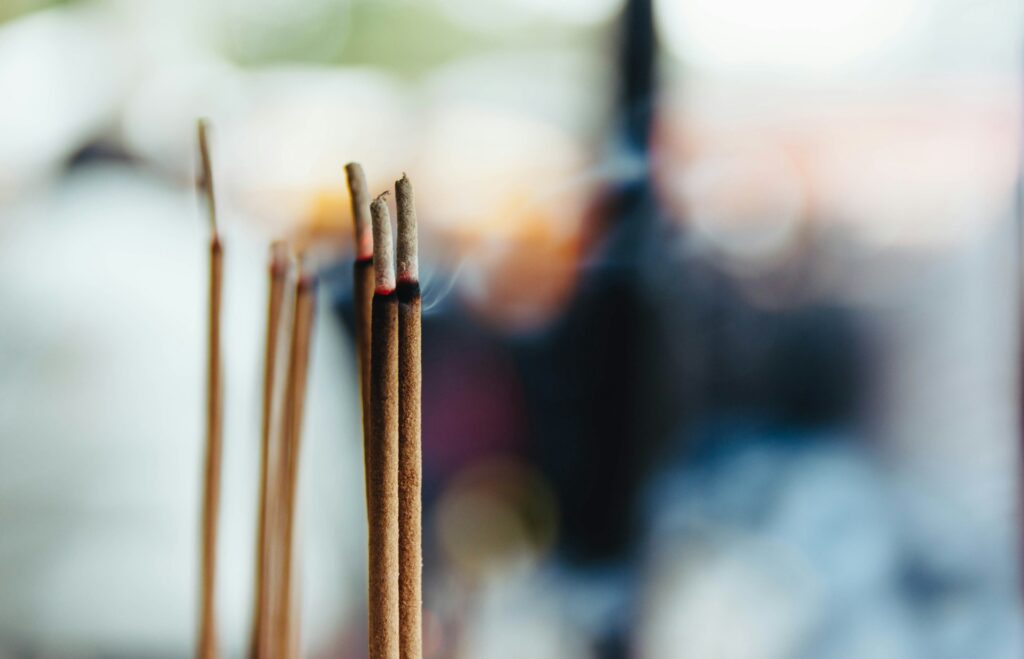
simple gesture places a stick of incense in
the bronze pot at the foot of the Buddha,
manifests the truth of the awakened
ones.”
~ Nan Shan

A Kusen by Guy Mokuhô Mercier

By Teachings / Resources

In zazen as in kinhin, we practise relaxation of our entire body. But relaxation is sometimes difficult because we don’t know what to do with our legs, our knees, and also with our pain.

Relaxing in our verticality, is in a way opening up, and being able to see what prevents us from this opening up or what opposes to it in our body.

Opening up to “that which comes to us”, to what appears in us, in our own mind, in our own body. That which comes to us is life, and this can only be perceived in the present moment, in what we feel or see. Then we turn our gaze inwards, and that is in fact an act of consciousness. We can involve our conscious gaze on what is happening in ourselves, now.

Our gaze internalizes itself, consciousness returns to what is alive, and ceases to lose itself in thoughts.

Without the perception of sensations we could not have the consciousness of our body. So it is through sensations that we become aware of the space of the body.

It is not limited by the surface of the skin and when we study our sensations, for instance that of the hands during zazen, we realize it is difficult to feel an inside and an outside. Our hands are a space of consciousness, the sensation itself melts with the consciousness that looks at it. Non-duality.

Buddha would recommend to “perceive the sensation within the sensation”. That means to enter a sensation that we have chosen completely, to study it, to look at it, to get into it. The sensation within the sensation becomes pure sensation of being, sensation of one’s presence which is not really physical, sensation of a space which has no limits really.

And this sensation you have chosen you can widen to your entire body and realize that consciousness is everywhere at the same time. You cannot find a top or a bottom in it, nor a beginning and an end. When we are in this consciousness, we have the knowledge of silence, even if there is noise around.

This presence, this consciousness of the Presence is our intimacy really, it is the space in which our life, our body, our thoughts are perceived, where they appear, where they extend and where they disappear.

Consciousness has no form, but it watches forms.

It is not a sensation, but it is aware of sensations.

Consciousness is not a thought, but it watches thoughts and  when it gets involved in them, in a way it becomes absent to itself.

That is why you must keep a distance from your thoughts and just watch them pass along.

Buddha would use the comparison with a mirror : consciousness, as pure perception, when there is no ego to take it over, can be compared to a clear mirror, where forms, sensations, thoughts and all the world of phenomena appear as reflections. Our meditation consists in being the mirror that remains empty, although reflecting all appearances, all forms. We come back to this mirror which does not seek appropriation, which does not try to seize or reject things, which is peaceful, luminous, which sees all without taking sides, which never interferes.

Buddha says : “when we realize that our own body, its possessions, its sensations, its perceptions and the space occupied by this body are nothing but the field of experiment of consciousness, when we realize this, we no longer need to take over for anything ; there is no more object for appropriation.”

The just vision consists in sticking constantly to this realization, without ever giving it up.

Kusen de Guy Mokuhô

The mind of awakening of the bodhisattva

By Teachings / Resources

by Guy Mokuho Mercier

June 2017

Teaching

Shantideva said , the mind of awakening presents two aspects. On  one side, the wish to awaken and on the other, engagement in awakening. When we come  and sit in the dojo , we reply to this mysterious inner intention towards the awakening of the mind and we participate in awakening, even without necessarily understanding it.

So, hold fast to this mind of awakening, for it is your own treasure.  Continues Shantideva.

And what is our own treasure?

It is what the Buddha called ‘the treasury of the eye of the True Law’ or Shobogenzo the title that Master Dogen gave to his work. It is to find this treasure that we come and  practise in the dojo. Sitting, with full consciousness of what Is, we fulfil the true purpose of  our existence. The my stery reveals itself in Presence. We sit and we see impermanence, the appearance and disappearance of things , neither seizing nor rejecting. Letting oneself  Be, without fighting the weight and resistance of discriminatory thoughts, conditioned
opinions, hopes and fears. An unconditional acceptance of what appears in our own minds, which contemplates the Treasure of the Eye Genzo. Not doing anything, but alive,  attentive and curious , free from the wish to become this or that.

For to feel sensations, to hear sounds, smell odours, see light and colours, to contemplate   impermanence , we don’t have to make any effort. Simply to accept ‘what comes to us’ and  keep our eyes open. It is just a question of trusting ourselves, and letting ourselves Be in  the present moment, which cannot be grasped, and to see ourselves in our own light. The  Treasure is always there already and the mind of awakening reveals it to itself.

Shantideva continues

< At the very moment when the mind of awakening arises in us, the most miserable prisoners of Samsara deserve the name of Bodhisattva >

We do not become a bodhisattva in forcing our will to run towards an imaginary future. It isn’t a name that rewards efforts, nor a new status to distinguish us from others!

The mind of awakening is our own Treasure of the .eye , and when in the living Presence, it lights up in us, we find the bodhisattva which we have always been, someone fundamentally good and loving. One with all things and all beings. There is no more separation, no more subject nor object, simply total engagement in awakening, which happens on its own (genjo koan) This is the secret of zazen, accepting letting oneself Be,
simply that. This is how the Bodhisattva reveals itself.

< Do not abandon the mind of awakening, Shantideva recommends, and you will cross the thousand pains of existence, you will calm the sufferings of beings and you will taste  thousands and thousands of joys. I have something to offer to beings. I renounce myself  and give myself completely to Buddha, with no reservation. >

Shantideva (685 – 763) was an Indian monk of the middle Way (madhyamika) one of the main schools of Mahayana buddhism.

Samsara is the world of perpetual wandering, the world of illusion, of the conditioned self.